
“I Didn’t Know Breathing Could Feel Like This”: Understanding MARPE and Airway Health
Editor’s Note
Lisa, Adam, and Jen are members of the Rebis Health clinical and leadership team. Their experiences with MARPE treatment are their own, shared here because they believe firsthand understanding of the patient journey makes them better providers and better advocates for the care they offer.
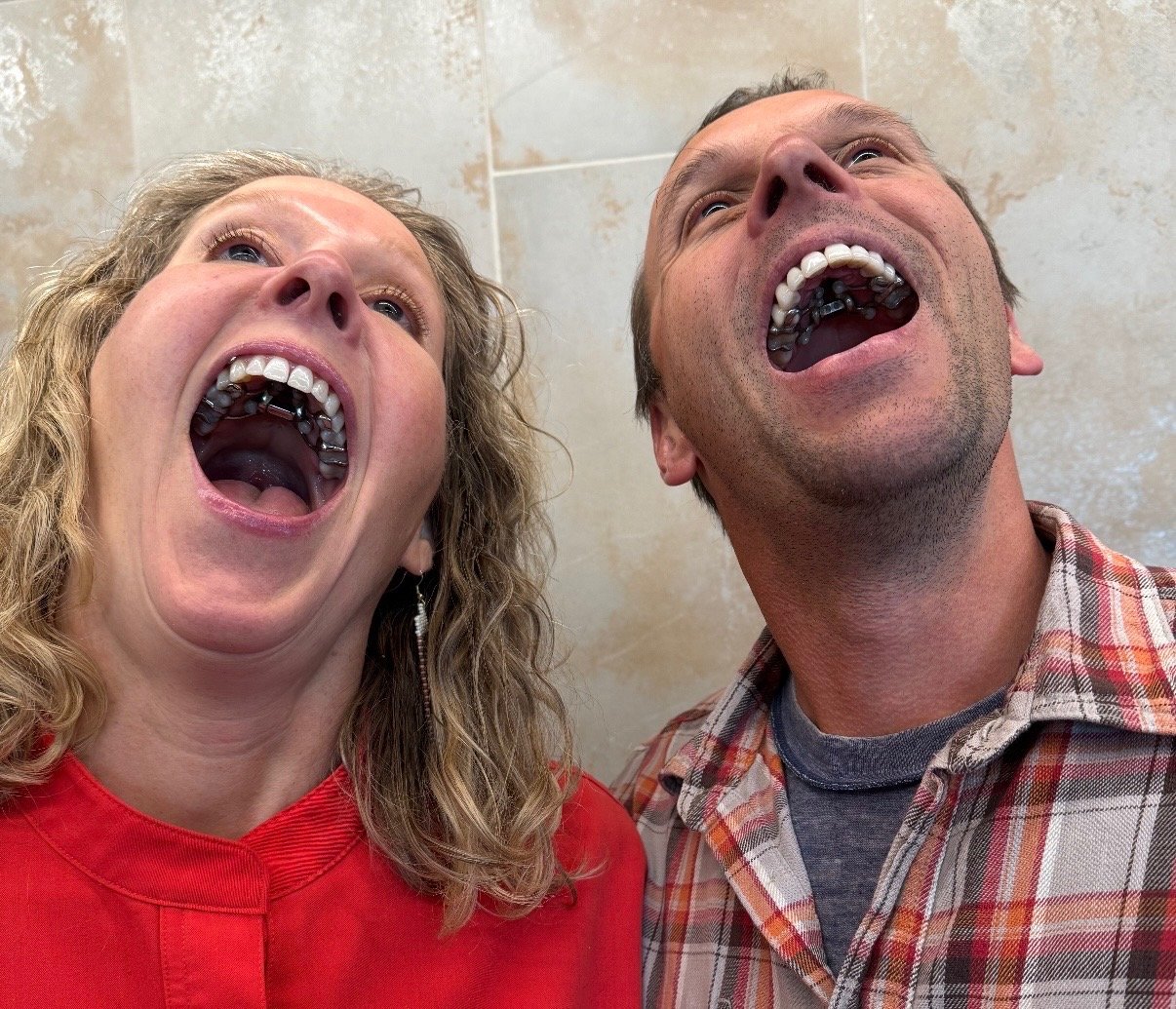
Lisa and Adam, two members of the Rebis Health leadership team, showing their MARPE appliances. Both underwent treatment as part of their own airway health journey.
~ ~ ~ ~ ~
“I’m breathing right now. This is new for me.”
When Lisa Coburn said those words during a recent Rebis Health discussion on MARPE treatment, the room went quiet.
Not because the statement was dramatic.
Because it was sincere.
After decades of struggling with restricted breathing, sleep disruption, airway dysfunction, and the feeling that something in her body had never fully worked the way it should, she was experiencing something many people take for granted:
Breath.
Not survival breathing. Not compensatory breathing. Not forcing air through a narrow airway.
Actual ease.
For many patients exploring MARPE, that realization becomes the emotional center of the journey.
At Rebis Health, we believe these stories matter because airway health is about far more than straight teeth or cosmetic orthodontics. It is about sleep, breathing, nervous system regulation, energy, development, and long-term whole-body health.
~ ~ ~ ~ ~
What Is MARPE?
MARPE stands for Microimplant-Assisted Rapid Palatal Expansion.
In simple terms, it is an adult palatal expansion technique designed to widen the upper jaw using small temporary anchorage devices, often called TADs, that anchor directly into the bone of the palate.
Unlike traditional expanders that primarily push against teeth, MARPE is considered bone-borne.
That distinction matters.
Traditional tooth-borne expanders can create outward tipping of the teeth, especially in adults whose palatal sutures are more resistant to change. MARPE was developed to create more true skeletal expansion by anchoring directly into bone.
At Rebis Health, we often explain it this way:
“The roof of the mouth is the floor of the nose.”
When the palate expands, the nasal floor may expand with it. That can increase the “real estate” inside the nasal airway and create more room for airflow, tongue posture, and functional breathing.
Or, as Lisa often tells patients:
“Your tongue is homeless.”
~ ~ ~ ~ ~
Does the Tongue Have a Home?
One of the first questions airway-focused providers ask is deceptively simple:
Does the tongue have enough room?
When the upper jaw is narrow, the tongue may not fit comfortably within the palate. Instead, it can become displaced backward into the throat, particularly during sleep.
This can contribute to:
Mouth breathing
Snoring
Poor sleep quality
Daytime fatigue
Tongue scalloping
Airway narrowing
Difficulty swallowing
Chronic tension patterns
Lisa describes the anatomy using a memorable analogy:
“It’s like Pillsbury biscuit dough exploding out of the can. The tongue is trapped on three sides and the only place left for it to go is backward into the airway.”
For many patients, this structural relationship has existed since childhood without ever being recognized.
~ ~ ~ ~ ~
Why More Adults Are Learning About MARPE
For years, many providers believed adult palatal expansion was either impossible or required highly invasive surgery.
Newer imaging technology and airway-centered orthodontic approaches have changed that understanding.
“We used to think the palate fused completely in adulthood,” Lisa explained during the discussion. “Now we know it’s more like a zipper. It’s not fused shut. It’s just tightly woven.”
That distinction has opened new possibilities for appropriately selected adults struggling with narrow palates, restricted nasal breathing, and airway dysfunction.
At Rebis Health, treatment planning may involve:
3D CBCT imaging
Airway analysis
Rhinomanometry
Functional breathing assessment
Tongue posture evaluation
The goal is not simply widening teeth.
It is understanding how structure influences breathing and sleep physiology.
~ ~ ~ ~ ~
MARPE vs Traditional Expanders
One of the most important distinctions in airway orthodontics is the difference between tooth-borne and bone-borne appliances.
Traditional expanders primarily rely on the teeth for support. In younger children, this may still achieve meaningful skeletal change because the sutures are more adaptable.
In adults, however, excessive force on the teeth can create:
Tooth tipping
Relapse
Periodontal strain
Instability
MARPE attempts to reduce those issues by anchoring directly into bone.
“The only way to truly grow the nasal floor is to truly grow the palate,” Lisa explained.
This distinction is especially important for patients whose goals extend beyond aesthetics and into functional breathing improvements.
~ ~ ~ ~ ~
Airway Health Is About More Than the Nose
One of the most compelling moments in the discussion came when the conversation shifted toward traditional ENT approaches.
Jen Kirkham described the difference using an apartment analogy.
If four people are crowded into a tiny apartment, removing furniture may temporarily create more space. But it does not change the size of the apartment itself.
Similarly, many airway procedures remove tissue without changing the underlying skeletal foundation.
MARPE approaches the problem differently by attempting to expand the foundational structure itself.
This does not mean surgery or tissue reduction procedures are never necessary. Some patients may still require additional ENT care. But airway-focused providers increasingly recognize that structural expansion may need to occur before removing anatomy.
~ ~ ~ ~ ~
The Emotional Side of Airway Treatment
One of the most overlooked aspects of airway-centered care is how emotionally vulnerable treatment can feel.
Dental procedures already place patients in highly vulnerable positions. For patients with previous trauma, chronic illness, swallowing dysfunction, claustrophobia, or nervous system dysregulation, airway procedures can become emotionally intense experiences.
During the discussion, both Lisa and Adam described unexpectedly revisiting old trauma during treatment.
Adam’s anxiety stemmed largely from childhood dental trauma after a facial injury shattered his upper palate.
“I had to reopen that can of worms,” he shared. “I had to relive it to let it go.”
Lisa described a different form of vulnerability.
Because of her severe airway restriction and difficulty swallowing, lying back while numb created intense sensations of panic and loss of control.
For many patients, these experiences are not psychological weakness. They are nervous system responses tied to breathing, airway restriction, prior trauma, and survival physiology.
This is one reason trauma-informed care matters deeply in airway medicine.
At Rebis Health, we recognize that airway treatment is not simply mechanical.
It is profoundly human.
~ ~ ~ ~ ~
Real Patient Stories: Why They Chose MARPE
Jen’s Story
After a devastating car accident in 2002 fractured much of her face and damaged her smile, Jen initially pursued treatment for cosmetic reasons.
But while exploring restorative dentistry, she discovered something unexpected:
She had mild sleep apnea and inadequate room for her tongue.
Her symptoms had seemed disconnected for years:
Morning headaches
Nighttime panic sensations
Interrupted sleep
Chronic tension
As she learned more about airway physiology, she realized the issue was structural.
“What I didn’t know,” she said, “was that it would eradicate my sleep apnea and reduce those panic episodes.”
Adam’s Story
Adam’s journey also began with trauma.
A childhood accident shattered his upper palate, leading to decades of breathing difficulties, fatigue, brain fog, dark circles under his eyes, and eventually obstructive sleep apnea.
CPAP and oral appliances helped partially, but he wanted to understand whether the underlying anatomy itself could be addressed.
For Adam, the hardest part was trust.
“Putting yourself in the hands of another human being to help you breathe,” he said, “is a really powerful thing.”
Within weeks of treatment, he reported dramatically easier nasal breathing.
Lisa’s Story
Lisa’s path was rooted in years of subtle symptoms that only later made sense through the lens of airway health.
Bedwetting. Mouth breathing. Swallowing dysfunction. Chronic nervous system dysregulation.
After seeing imaging that showed an airway diameter of only 1.2 millimeters, she realized that softer interventions alone were unlikely to create sufficient structural change.
“I have to move bone,” she said. “I need more runway for my tongue.”
Despite difficult moments during treatment, she described becoming emotional simply from experiencing improved breathing for the first time.
“I’m almost overwhelmed,” she shared. “What am I going to do with all this breath?”
~ ~ ~ ~ ~
Who Is a Candidate for MARPE?
There is no single “perfect” candidate.
Treatment depends on anatomy, developmental stage, airway function, bone quality, and overall health.
Potential considerations include:
Narrow palate
Chronic mouth breathing
Sleep-disordered breathing
Tongue crowding
Airway restriction
Relapse after orthodontics
Structural craniofacial underdevelopment
Certain conditions may require additional caution or alternative approaches, including:
Severe bone loss
Prior jaw surgeries
Certain connective tissue disorders
Complex nasal surgeries
Significant anatomical abnormalities
This is why individualized evaluation matters.
~ ~ ~ ~ ~
Beyond Cosmetic Orthodontics
At Rebis Health, airway-centered treatment is never just about creating a wider smile.
It is about function.
Better breathing. Better sleep. Better recovery. Better nervous system regulation.
Because when breathing is compromised, the effects can ripple throughout nearly every system in the body.
As Adam reflected during the conversation:
“You can spend all the money you want on supplements, exercise, and nutrition hacks. But if you’re not sleeping and breathing properly, nothing else matters.”
Sleep and breathing are foundational.
Awaken. Empower. Heal.
~ ~ ~ ~ ~
Interested in Learning More About MARPE?
If you are struggling with mouth breathing, sleep-disordered breathing, CPAP intolerance, or chronic fatigue and would like to explore whether airway-focused treatment may be appropriate for you, our team is here to help.
Visit our MARPE page for frequently asked questions and additional educational resources, or reach out through our Contact Us page to connect with the Rebis Health team.
~ ~ ~ ~ ~
References
Suzuki, H., Moon, W., Previdente, L. H., & Garcez, A. S. (2021). Microimplant-assisted rapid palatal expansion (MARPE): A review of the literature. Progress in Orthodontics, 22(1). https://pmc.ncbi.nlm.nih.gov/articles/PMC7966493/
Lee, K. J., Park, Y. C., Park, J. Y., & Hwang, W. S. (2010). Miniscrew-assisted nonsurgical palatal expansion before orthognathic surgery for a patient with severe mandibular prognathism. American Journal of Orthodontics and Dentofacial Orthopedics, 137(6), 830–839.
Rebis Health MARPE discussion transcript and patient interviews.
