
By Rebis Health · Medically reviewed by the Rebis Health dental team
Quick answer: Airway dentistry for kids looks at how a child's jaws, palate, tongue, and nose work together for breathing, especially during sleep. Timing matters because much of the face's growth happens in childhood. When a breathing concern is found while a child is still growing, families usually have more gentle, growth-guided options to discuss.
Key takeaways
Snoring most nights is worth a question, not a wait. The American Academy of Pediatrics recommends that all children be screened for snoring.
Mouth breathing, a narrow upper jaw, and large tonsils or adenoids may be linked to sleep-disordered breathing in children.
Research on palatal expansion and myofunctional therapy is encouraging but limited, so they work best in a team plan that starts with a sleep evaluation.
What is airway dentistry for kids?
Airway dentistry for kids looks beyond cavities and straight teeth. It asks how a child's jaws, palate, tongue, and nasal passages support easy nose breathing, day and night. The goal is to notice growth patterns that may be linked to snoring or sleep-disordered breathing while a child is still growing. You may also hear it called airway-focused dentistry, functional dentistry, or airway orthodontics.
Is it a real field? Yes, as a focus rather than a specialty. It is not one of the 12 dental specialties the ADA's National Commission recognizes, but in 2017 the ADA adopted a policy that dentists should assess patients' risk for sleep-related breathing disorders. Good care usually involves a small team:
| Who | What they look at |
|---|---|
| Pediatrician | Screens for snoring and coordinates care |
| Sleep physician | Confirms what happens at night with a sleep study |
| ENT | Tonsils, adenoids, and nasal blockage |
| Pediatric dentist or orthodontist | Jaw and palate growth, and expansion |
| Myofunctional therapist | Tongue posture, lip seal, and breathing habits |
| Allergist | Allergies that keep the nose blocked |
Why timing matters: a child's face is still being built
A child's face is not a small adult face. The jaws and palate are still growing, and how a child breathes, swallows, and rests the tongue grows along with them. A major review describes a continuous interaction between orofacial function and facial growth after birth. In a classic 1981 study, young monkeys whose noses were blocked kept their mouths open, and their faces and bites developed differently over time. It was an animal study, and human evidence is mostly observational.
What Dr. Kevin Boyd's research adds
Dr. Kevin Boyd, Rebis Health's Chief Dental Officer, is a board-certified pediatric dentist and a dental consultant to the Sleep Medicine Service at Lurie Children's Hospital in Chicago. In a 2021 paper, he and colleagues argue that modern diets, starting in infancy, have contributed to a widespread rise in problems with how the face and mouth develop, and that there is a growing need to address them in early childhood. In a 2025 review, he notes that these problems usually first show up in the baby teeth, around ages 2.5 to 7, and tend to grow more complex with age.
Why the palate has a window
The upper jaw has a center seam called the midpalatal suture. A CBCT study of 140 people found it usually stays in its earlier, less interlocked stages until about age 13, with later stages appearing mostly between 11 and 17. That is why widening the upper jaw tends to be simpler in childhood, while older teens and adults often need anchored appliances like MARPE or surgery.
How are mouth breathing and a narrow palate linked to snoring?
They are linked through space and airflow. When the nose is blocked by large adenoids, allergies, or narrow nasal passages, a child breathes through the mouth. Over time, an open-mouth, low-tongue resting posture may be linked to a narrower upper jaw, and a narrower jaw can leave less room for air during sleep. Researchers still debate how much each piece drives the others.
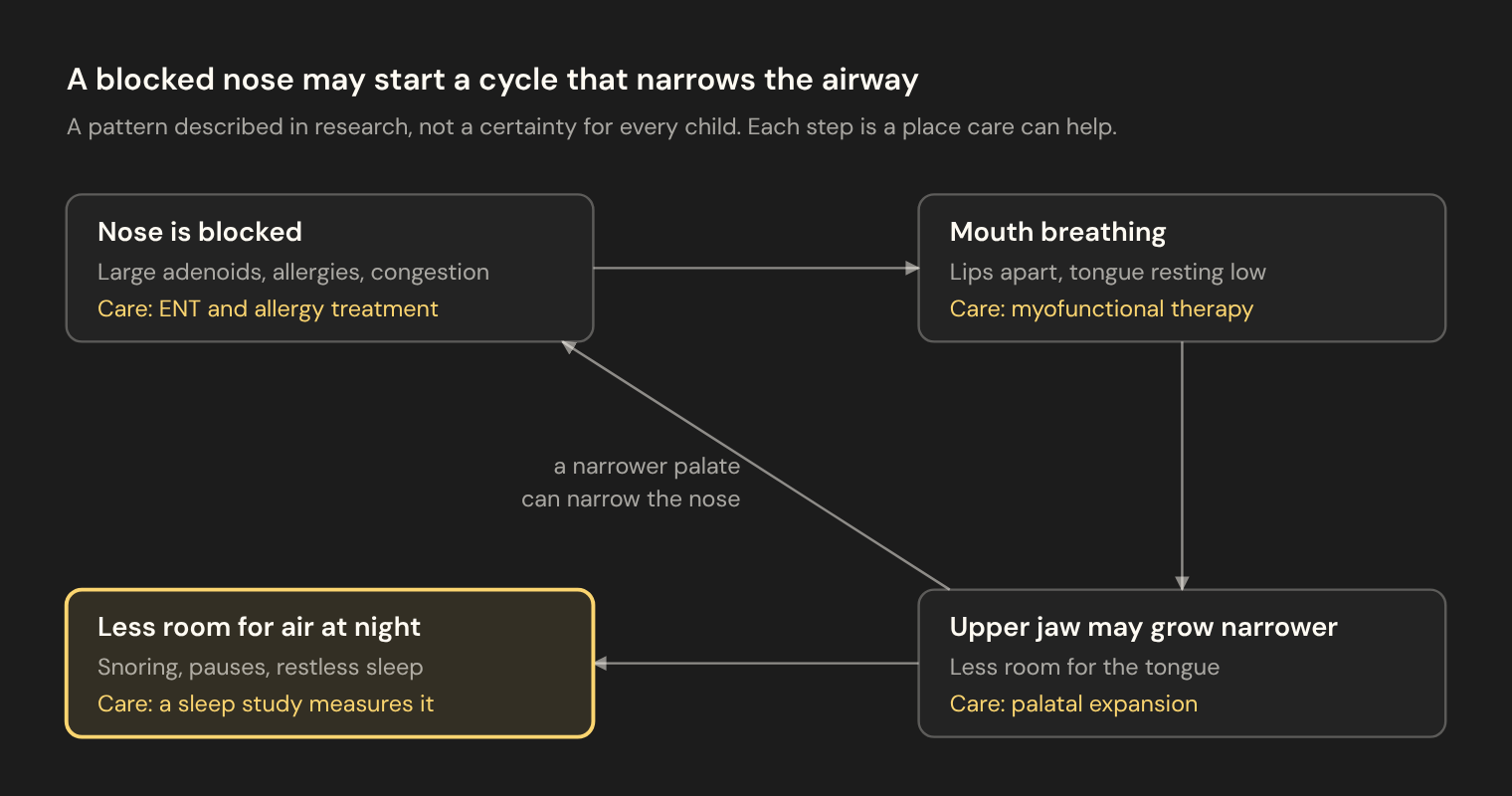
What the research supports so far:
Mouth breathing is one of the most common harmful oral habits in children, often driven by large adenoids or tonsils, and it may affect how the teeth and jaws develop.
About 7.5% of children snore, by parent report, while sleep apnea confirmed by testing affects about 1 to 4%. Snoring is a reason to ask, not a diagnosis.
A narrow upper jaw is one of several craniofacial features linked to pediatric sleep apnea, though experts rate that evidence as low to very low quality.
"They'll grow out of it." Maybe.
In the CHAT trial of 464 children ages 5 to 9, sleep studies normalized after seven months in 79% of children who had tonsil surgery and 46% of those who waited. Some children do outgrow it, and some still have signs after surgery. The only way to know is to check.
Signs worth a question
Snoring with a cold is common. Snoring without one, three or more nights a week, is worth a question. The AAP recommends a sleep evaluation for children who snore regularly and have other symptoms. Save this list for your pediatrician, or for us.
At night
☐ Snoring three or more nights a week
☐ Pauses in breathing, gasps, or snorts
☐ Restless, sweaty sleep or the head tipped far back
☐ Bedwetting that returns after six months of dry nights
☐ Breathing through the mouth while asleep
During the day
☐ Hard mornings or headaches on waking
☐ Sleepy, or the opposite: wired and restless
☐ Trouble with attention, mood, or learning
☐ Mouth open at rest, or a nose that always seems stuffy
What a dentist or doctor may notice
☐ Large tonsils
☐ A high, narrow palate or crowded baby teeth
☐ A small or set-back lower jaw
In a study of about 9,000 children in England, early snoring, mouth breathing, and pauses were linked to 20% to 100% higher odds of behavior problems at ages 4 and 7. That is a link, not proof of cause.
What does airway-focused care for kids include?
Care starts by finding out what happens during sleep, then matching treatment to the cause.
History and screening: sleep, snoring, behavior, allergies, and feeding.
A sleep study to measure breathing and oxygen overnight. Rebis offers pediatric sleep testing from age 3.
An airway and growth exam of the nose, tonsils, tongue, palate, and bite.
A plan matched to the cause, then a recheck to confirm breathing improved.
| Option | What the evidence says |
|---|---|
| Tonsil and adenoid surgery | First-line when they are enlarged, per the AAP |
| Allergy care and nasal steroid sprays | Nasal steroid sprays are an option for mild sleep apnea when surgery is not the right fit, per the AAP |
| Palatal expansion | Breathing events fell about 70% on average across 314 children, but only about 1 in 4 fully resolved |
| Myofunctional therapy | About a 62% drop in breathing events in very small studies; best as support for other care |
| CPAP | For sleep apnea that remains after surgery, or when surgery is not an option |
Every option has trade-offs. Expanders can tip anchor teeth and thin nearby bone, so expansion should be planned and monitored by an experienced orthodontist.
Dr. Bret Christensen's approach to guided growth
Dr. Bret Christensen, Rebis Health's Director of Developmental Dentofacial Orthopedics, is an orthodontist with more than 30 years of experience and a Diplomate of the American Sleep and Breathing Academy. He focuses on guiding jaw growth through early orthopedic expansion rather than straightening teeth alone, and his team measures the airway before and after treatment so changes are tracked with numbers.
Is pediatric airway dentistry legit? What the research says, and what it doesn't yet
Yes, as a young and growing area of care. The link between facial growth and breathing is well described. Proof that early dental treatment prevents sleep apnea later in life does not exist yet.
Well supported
Screening all children for snoring, and testing those who also have other symptoms (AAP).
Tonsil surgery when tonsils and adenoids are enlarged (CHAT trial), with dentists screening and referring as part of a physician-led team (Kazmierski, 2024).
Promising, still being studied
Palatal expansion, especially for children with small tonsils or prior tonsil surgery (Camacho et al.).
A small 2026 trial, with 36 children completing follow-up, of kids with mild to moderate sleep apnea and a set-back lower jaw found dental orthopedic appliances worked about as well as tonsil surgery over seven months. High dropout makes it a signal, not an answer.
Not proven yet
A Cochrane review found insufficient evidence to support or refute oral appliances for sleep apnea in children.
Sleep apnea cannot be diagnosed from jaw shape alone; it takes an interdisciplinary evaluation.
For newborns, the AAP says it is not clear that tongue-tie release improves breastfeeding. For older children, ask what a release is meant to fix and how success will be measured.
Questions to ask any airway provider
Will my child have a sleep study before and after treatment?
Do you work with a sleep physician, an ENT, and our pediatrician?
What will this change, how will we measure it, and what happens if we wait?
Things many parents don't know
Kids with disrupted sleep often don't look sleepy. Many seem restless, irritable, or unfocused instead. The AAP lists attention and learning problems among the signs worth a closer look.
A stuffy nose counts. A blocked or congested nose is a common reason children breathe through the mouth, so caring for the nose is part of caring for the airway.
Early feeding may play a role. In a meta-analysis of 41 studies, children who were ever breastfed were less likely to develop bite problems. The data are observational, and many formula-fed children grow beautifully.
Grinding can travel with snoring. A 2024 review found grinding and sleep-disordered breathing often appear together in children, though that evidence is low quality.
Mouth taping is not for kids. A 2025 systematic review found a potentially serious risk of harm, especially when the nose is blocked. If your child can't breathe easily through the nose, ask a clinician why.
How Rebis Health approaches airway care for kids
Rebis Health brings sleep medicine and airway dentistry into one team. Each plan starts with Dr. David McCarty's Five Finger Approach, which looks at sleep timing, medical factors, the airway, behavior and environment, and specific sleep disorders. Dr. Boyd and Dr. Christensen lead airway and growth care, with myofunctional therapy when it fits. We work with your pediatrician and ENT as partners, never replacements, and our focus is root-cause care that helps children heal and grow well.
Your next step
You've been on the night shift. You don't have to keep guessing. If your child snores most nights, breathes through the mouth, or wakes up tired, bring it to your pediatrician, or to us. Request a pediatric sleep evaluation in Westminster, Boulder and Longmont, Lone Tree, or Frisco.
Educational content only. Not medical advice.
Frequently asked questions
Is pediatric airway dentistry legit?
Yes, as a focus within dentistry rather than a separate ADA specialty. It works best inside a team, with a sleep study and a physician's diagnosis guiding treatment.
What does a pediatric airway dentist do?
They check how the jaws, palate, tongue, and bite affect breathing, screen for sleep-disordered breathing, and refer for testing. Depending on the cause, they may guide jaw growth or coordinate myofunctional therapy.
At what age should my child be evaluated?
The AAP recommends asking about snoring at routine checkups for all children. Bite problems often first appear in the baby teeth, around ages 2.5 to 7, and Rebis offers pediatric sleep testing from age 3.
Can airway dentistry prevent snoring or sleep apnea?
It may reduce snoring and breathing events for some children, especially when a narrow upper jaw is involved. Research has not yet shown that it prevents sleep apnea later in life.
Does mouth breathing change a child's face?
It may. Reviews link long-term mouth breathing to differences in jaw and tooth development, so finding out why a child mouth breathes comes first.
Is airway care covered by insurance?
Coverage varies by plan. Sleep testing and physician visits are usually billed to medical insurance, while dental appliances may fall under dental benefits, so check with your insurer and our team.
Sources
Marcus CL, et al.; American Academy of Pediatrics. Diagnosis and management of childhood obstructive sleep apnea syndrome. Pediatrics. 2012;130(3):576-584.
Marcus CL, et al.; CHAT. A randomized trial of adenotonsillectomy for childhood sleep apnea. N Engl J Med. 2013;368(25):2366-2376.
Lumeng JC, Chervin RD. Epidemiology of pediatric obstructive sleep apnea. Proc Am Thorac Soc. 2008;5(2):242-252.
Guilleminault C, Huang YS. From oral facial dysfunction to dysmorphism and the onset of pediatric OSA. Sleep Med Rev. 2018;40:203-214.
Harvold EP, et al. Primate experiments on oral respiration. Am J Orthod. 1981;79(4):359-372.
Boyd K, Saccomanno S, Lewis CJ, Coceani Paskay L, Quinzi V, Marzo G. Myofunctional therapy. Part 1: Culture, industrialisation and the shrinking human face. Eur J Paediatr Dent. 2021;22(1):80-81.
Boyd K. Malocclusion and SRBD: screening and treatment can change children's lives. Dental Sleep Practice. April 30, 2025.
